
Do you need a product or a process? Rethinking what drives a successful project.
In planning and development, we tend to place a lot of emphasis on delivering a great product.
By product, we mean the tangible outputs of a project, such as the strategy, the report, the policy, or the planning application. These are the things that get reviewed, approved, and ultimately relied upon to move a project forward. It’s understandable that they receive so much attention. Products are visible, accountable and definitive.

Sometimes even the most well considered product can end in tangle, if not supported by an effective process.
But in practice, focusing too heavily on the product can obscure something equally important: the role of the process in shaping whether that product is actually effective, efficient, and viable.
A technically robust product does not always translate into a successful project. Not because the work is flawed, but because it hasn’t been understood, developed, or refined by the people who needed or the project to be successful. Without buy-in, even a well-considered and argued product can struggle to gain traction.
This is where process begins to really matter.
Process is often thought of as a necessary step on the way to a deliverable. It is something to be ‘managed efficiently’ rather than designed deliberately. However, on more complex projects, particularly those involving multiple stakeholders, competing priorities, or difficult decisions, the process is often doing the real work to driving project outcomes. We see this most clearly on projects where delivery depends on alignment across different parties.
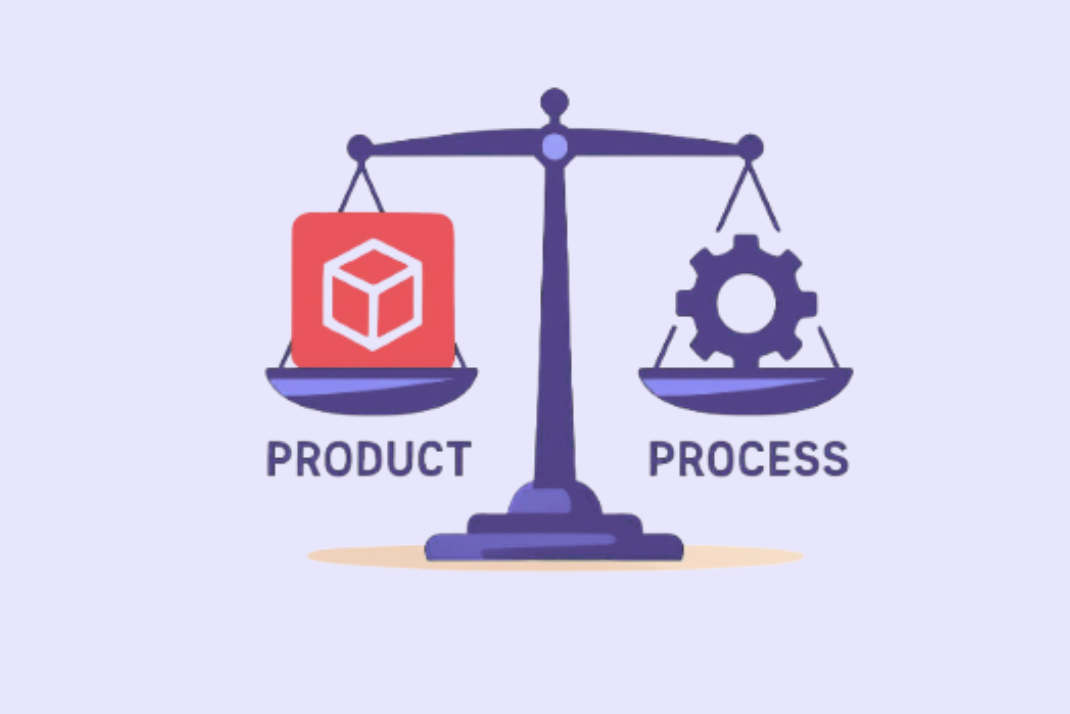
Weighing up when you need a product and when a process is needed to drive change
Through conversations, workshops, and iterative testing, a good process helps to surface risks early, challenge assumptions, and build a shared understanding of both constraints and opportunities. It creates space for different perspectives to be explored, empathy to grow and the relationships formed that are required for successful implementation.
A well-designed process also helps to manage the timing and scale of decision-making. Many projects involve a series of complex and interrelated decisions. If these are left unresolved until later stages, they tend to concentrate risk, create pressure, and often lead to delay or rework. An effective process can break these decisions down into manageable parts and address them progressively. This allows key issues to be tested early, reduces uncertainty over time, and avoids the need for multiple critical decisions to be made at once.
Here, the process is key to actively de-risking the products successful delivery and becomes just as value to delivery on the ground, as the product itself.
This is not to suggest that process should always take precedence. Some projects need a clear, well-reasoned, and defensible product, before the process of deliver can start. Others rely on building alignment and testing ideas along the way.
The challenge in successful project delivery is determining when a product is necessary for a successful outcome and when the process itself is equally or more important.
Maybe a more useful starting point is to ask what the project needs to achieve. If the task is to provide clarity, the product should lead. If the task is to bring people along or enable implementation, the process matters more. In many cases, the most effective approach lies somewhere in between. A deliberate process builds understanding and momentum, leading to a product that is technically sound and capable of being implemented with confidence.
Ultimately, not every project requires an elaborate process, and not every project demands a highly refined product. However, being clear about which one is doing the heavy lifting can significantly change how a project is approached, and how successful it is in practice.
by Jennifer Richardson